
The Role of Data-Driven Video Ads in Boosting ROI
QuickAdVideo Team
Author
Running video ads without data behind them is like shooting in the dark. The role of data-driven video ads has shifted from a competitive advantage to a baseline requirement for marketers who want real, measurable results. Brands using personalized, analytics-backed video content report 2 to 4x higher click-through rates compared to generic video ads. This guide breaks down exactly how data shapes every layer of an effective video ad campaign, from creative decisions to real-time optimization, and what you need to do to execute it well.
Table of Contents
- Key takeaways
- The role of data-driven video ads in modern marketing
- Creative variables that actually move performance
- Performance outcomes from personalized video advertising
- AI and real-time analytics in video ad optimization
- Practical steps to implement data-driven video ad strategies
- My take on what data-driven video advertising actually demands
- Scale your video ads with Quickadvideo’s AI generator
- FAQ
Key takeaways
| Point | Details |
|---|---|
| Data drives creative choices | Hook style, brand timing, and CTA framing each have measurable impact on view-through and conversion rates. |
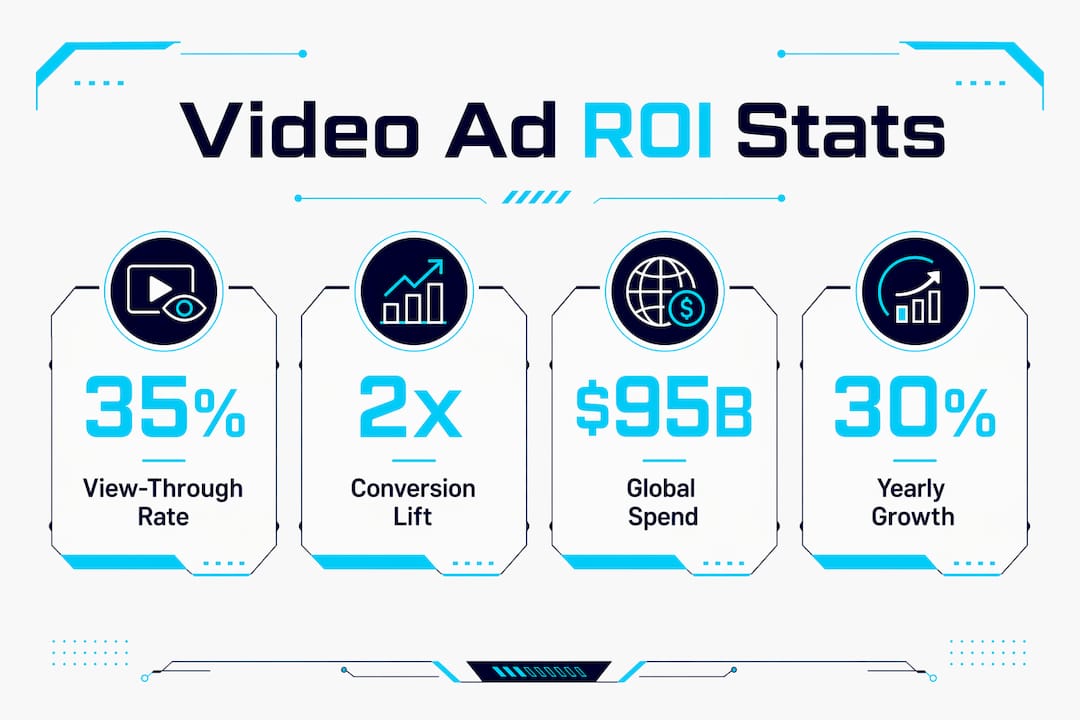
| First 3 seconds determine success | Videos with strong opening hooks yield 20 to 35% higher view-through rates than those without. |
| AI enables real-time optimization | Execution-layer AI continuously adjusts bidding, targeting, and creative delivery without human lag. |
| Vanity metrics undermine results | Most teams claiming to be data-driven rely on intuition; rigorous hypotheses and decision frameworks separate real performance gains from noise. |
| Testing standards matter | Running tests to 95% confidence with at least 10,000 users per variant prevents false positives and wasted budget. |
The role of data-driven video ads in modern marketing
Data-driven video advertising means every creative choice, targeting decision, and budget allocation is informed by actual audience behavior, not assumptions. You are not simply making a good-looking video and hoping it lands. You are building a system where signals from real users tell you what to make, who to show it to, and when to adjust.
The types of data feeding this system fall into a few clear categories:
- Demographic data: Age, gender, location, income bracket. This determines which version of your ad to show and on which platform.
- Behavioral data: Purchase history, browsing patterns, content engagement. This tells you where a viewer is in the buying journey.
- First-party data: Your own CRM, email lists, and pixel data. This is the most reliable signal because you own it and it reflects real customer relationships.
- Attribution data: Which touchpoint actually drove the conversion. Without this, you cannot evaluate what is working and what is wasting budget.
Integrated data infrastructure ties these inputs together. Without it, you end up with siloed reporting where your Facebook data never talks to your Google data, and your actual sales numbers live in a separate spreadsheet. That disconnect is where most data-driven video strategies fall apart.
The key performance indicators (KPIs) worth tracking for video ads include view-through rate, completed view rate, click-through rate, cost per acquisition, and return on ad spend. AI tools are increasingly central to this process. AI-driven video campaigns now continuously adjust creative, budget, and targeting based on live user behavior, replacing the static, set-it-and-forget-it model most teams still rely on.
Creative variables that actually move performance
The biggest bottleneck in video ad performance is not production capacity. It is strategic optimization of creative variables like hooks, brand presence timing, and CTA framing. These decisions look small but carry significant performance consequences.
The first three seconds
If your video does not hook attention in the first one to three seconds, most of your audience is already gone. Videos with engaging hooks yield 20 to 35% higher view-through rates than videos that open slowly or generically. The hook is not decorative. It is functional. Test opening with a bold statement, a question, a visual surprise, or a specific outcome the viewer wants. Each of those is a different creative hypothesis, and only data can tell you which one wins with your specific audience.

Brand presence and CTA framing
Brand presence needs to be timed carefully. Showing your logo in the first second can hurt engagement if viewers feel they are being sold to before receiving value. The data generally supports showing your brand after the hook has done its job, usually after the three-second mark.
For CTAs, specificity outperforms vagueness every time. Low-friction micro-actions like “See pricing” or “Watch how it works” increase click-through rates by 12 to 18% compared to generic prompts like “Learn more” or “Click here.” The difference is that specific CTAs set a clear, low-commitment expectation.
Testing these variables requires structure. A factorial test design lets you isolate each element independently. As a reference point, a properly structured creative test lifted 15-second view-through rates from 22% to 28% and conversions by 21% simply by changing the hook style and CTA framing.
- Define your hypothesis before you create variants. “We believe a question-based hook will outperform a statement hook for cold audiences.”
- Isolate one variable per test when possible. Changing the hook and the CTA simultaneously makes it impossible to know which drove the result.
- Set your decision threshold before launch, not after. Post-hoc threshold setting is how gut instincts sneak back into supposedly data-driven processes.
- Run the test long enough to collect statistically meaningful data. Two days and 500 impressions is not a test. It is a guess with extra steps.
Pro Tip: Tag every creative variant with metadata that captures the specific element being tested, the hypothesis, the format, and the platform. Over time, this metadata becomes a searchable library of what works for your audience, saving you from re-testing the same hypotheses repeatedly.
Performance outcomes from personalized video advertising
The numbers behind personalized video advertising are not incremental. They reflect a fundamentally different level of audience connection.
| Ad Type | Average CTR Lift | Conversion Rate Impact | Purchase Intent Lift |
|---|---|---|---|
| Generic video ad | Baseline | Baseline | Baseline |
| Targeted video ad | +40 to 60% | +10 to 15% | +20 to 30% |
| Personalized data-driven video | +200 to 400% | +25 to 30% | +60% |
Global personalized video ad spending exceeded $95 billion in 2025 and grew nearly 30% year over year. That number reflects where serious marketing budgets are moving, away from broad-reach generic content and toward precision targeting with tailored creative.
Landing pages amplify this effect significantly. Embedding video on landing pages can more than double conversion rates compared to text-only pages. B2B SaaS companies using explainer videos on their landing pages have seen conversion lifts exceeding 100%. That is not a minor improvement in layout. That is a structural change in how prospects engage with and decide on your product.
From a budget perspective, personalized targeting cuts waste. Instead of paying to show your ad to an audience that has no reason to care, you are spending against verified signals of purchase intent. Data-Driven Linear optimization even extends this precision to linear and streaming TV, where it scales impressions against measurable business outcomes without requiring proportional budget increases.
The efficiency argument is straightforward: the same ad budget deployed against a data-informed audience will consistently outperform the same budget spread broadly, because you are paying for relevance, not just reach.
AI and real-time analytics in video ad optimization
The shift from retrospective reporting to live optimization is the most significant operational change in video advertising right now. Traditionally, you ran a campaign for two weeks, pulled a report, drew conclusions, and adjusted for the next cycle. By the time you acted, the opportunity was often gone.
Execution-layer AI systems change that. They analyze live media data and apply real-time bid and pacing optimizations across multiple dimensions simultaneously. These are the capabilities that define current AI-powered campaign management:
- Real-time creative rotation: The system identifies which ad variant is performing better among a specific audience segment and shifts delivery toward that variant automatically.
- Dynamic budget reallocation: Rather than waiting for a scheduled review, AI redistributes spend across channels and placements based on which are meeting KPI targets right now.
- Multi-signal integration: Location, device type, time of day, weather, and browsing context can all feed into real-time bid adjustments, creating hyper-relevant delivery conditions.
- Predictive creative fatigue detection: AI flags when an audience is becoming desensitized to a specific creative, giving you time to refresh before performance drops sharply.
The practical result is that your campaigns align directly with business KPIs rather than platform-level proxy metrics. A click from someone who buys is worth far more than a click from someone who bounces. Execution-layer AI learns the difference and allocates accordingly.
Pro Tip: Before you trust any AI optimization output, validate your data pipeline. AI makes decisions based on whatever data it receives. If your attribution model has gaps or your pixel is misfiring, the AI will optimize toward a flawed signal with perfect efficiency. Garbage in, garbage out is still the rule.
Practical steps to implement data-driven video ad strategies
Getting started with data-driven video advertising requires infrastructure before tactics. You need clean data, clear measurement, and a testing culture before you can optimize anything meaningfully.
Start with your data foundation. Connect your CRM, ad platforms, and analytics tools so that audience segments and conversion data flow in both directions. Without unified attribution, you will rely on vanity metrics and intuition, which is exactly the trap that undermines most teams claiming to be data-driven.
| Challenge | Common Mistake | Better Approach |
|---|---|---|
| Attribution gaps | Using last-click only | Implement multi-touch attribution across channels |
| Testing rigor | Ending tests too early | Run to 95% confidence, 30 days minimum, 10,000 users per variant |
| Organizational resistance | Letting HiPPO opinions override data | Pre-define decision rules before results come in |
| Vanity metrics | Optimizing for views and likes | Tie every KPI to downstream revenue impact |
| Creative bottlenecks | Producing few variants at scale | Use AI production tools to create testable variants quickly |
The cultural piece is often harder than the technical piece. People are attached to their creative instincts, and data that contradicts those instincts can be dismissed rather than acted on. The fix is to pre-commit to decision rules. If variant A beats variant B at 95% confidence after 30 days, variant A wins. Full stop. That structure removes the politics from the process and keeps data-driven marketing actually data-driven.
Start small if you need to. Pick one campaign, define three hypotheses, test them rigorously, and document the outcomes. That discipline, applied repeatedly, compounds into a significant performance advantage over time. Learning more about getting started with AI video ads can help you structure your first tests without overcomplicating the setup.
My take on what data-driven video advertising actually demands
I’ve watched a lot of marketing teams declare themselves “data-driven” and then make every major creative decision based on what the CMO finds visually appealing. The data existed, but it lived in a dashboard nobody trusted enough to act on.
What I’ve learned is that the real discipline in data-driven video advertising is not collecting data. It’s having the organizational nerve to let data override opinion. Most teams are not short on analytics tools. They are short on pre-defined decision frameworks that make the data impossible to ignore.
The other thing I’ve seen repeatedly is that creative variables matter far more than production quality. A raw, authentic hook built around a specific audience insight will outperform a cinematic, high-budget open that says nothing new. The data shows this every time. The teams that win are the ones that treat every creative decision as a testable hypothesis, not a statement of taste.
AI production tools have removed the cost barrier to testing at scale. You can now generate multiple creative variants quickly, which means the bottleneck is testing discipline, not production budget. That changes the game entirely for teams willing to embrace it.
— iBoy
Scale your video ads with Quickadvideo’s AI generator
If you are serious about putting data-driven creative principles into practice, production speed matters. Quickadvideo is built specifically for business owners and marketing teams that need to generate multiple ad variants quickly and connect them to real performance data.
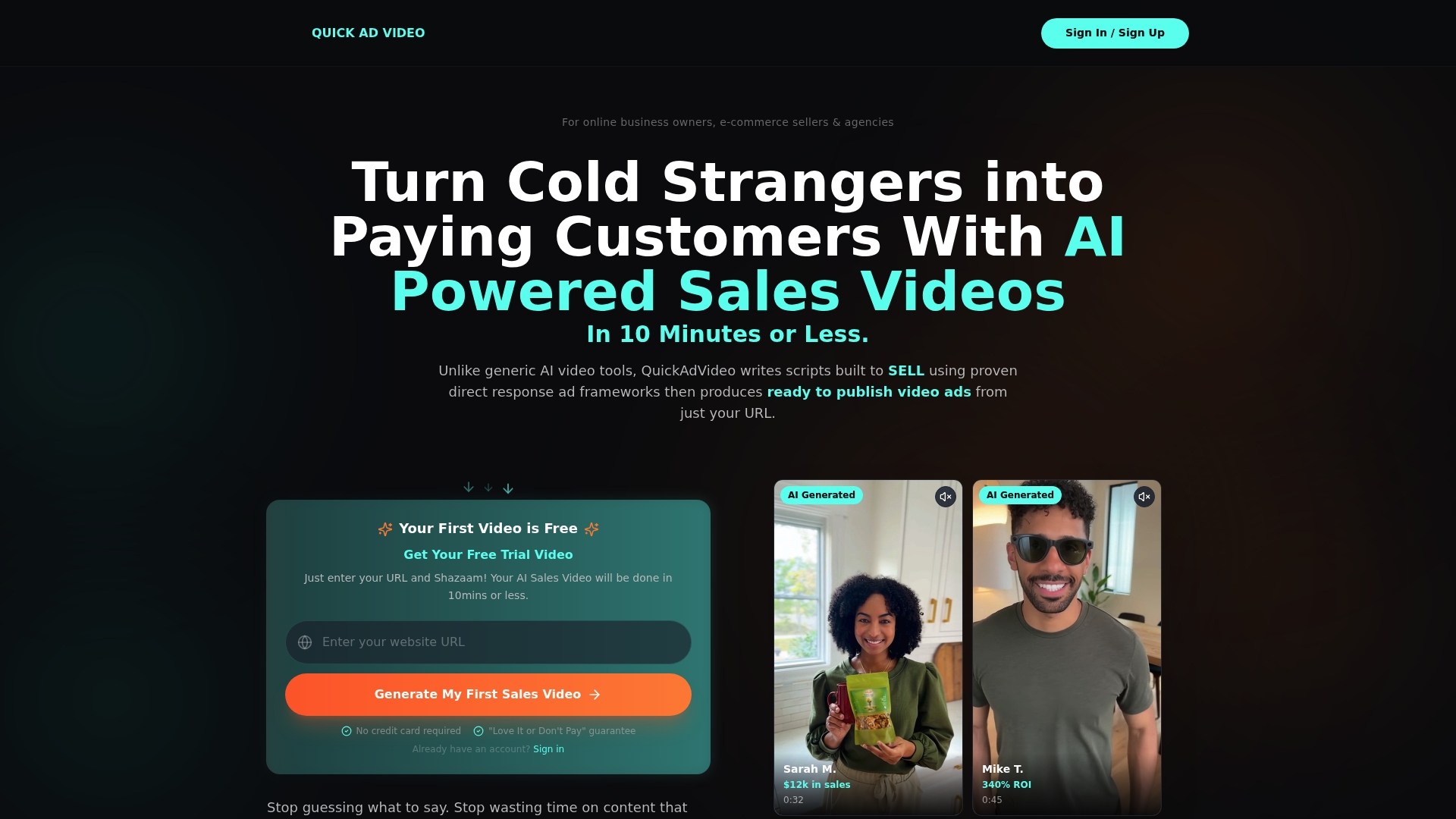
The platform generates high-converting sales videos from your product URL in minutes, with formats covering UGC, cinematic, and viral story styles. Each model is designed around direct-response frameworks, which means your creative variables, hook style, CTA framing, and brand positioning are already structured for testing and optimization. You can explore the full range of available video ad models to match the right format to your campaign objective. No editing skills required. No production team needed. Just faster, testable video at a cost that makes iteration practical.
FAQ
What is the role of data-driven video ads?
Data-driven video ads use audience behavior, demographic signals, and performance analytics to inform creative decisions, targeting, and budget allocation. The result is higher click-through rates, lower cost per acquisition, and stronger purchase intent compared to generic video advertising.
How do you measure video ad performance effectively?
Track view-through rate, completed view rate, click-through rate, cost per acquisition, and return on ad spend. Tie every metric to downstream revenue rather than surface engagement numbers like views or shares to get an accurate picture of campaign health.
Why does the first three seconds of a video ad matter so much?
Videos with strong opening hooks generate 20 to 35% higher view-through rates. If your audience does not see something relevant or compelling immediately, they scroll past, and the rest of your ad never gets delivered.
How does AI improve video ad campaign results?
Execution-layer AI analyzes live campaign data and continuously adjusts bids, creative rotation, and budget distribution against real business KPIs. This replaces manual, retrospective optimization cycles with a system that reacts in real time to what is actually working.
What is the biggest mistake in data-driven marketing?
Relying on vanity metrics and skipping rigorous test design. Most teams end tests too early or let subjective opinion override results. Setting 95% confidence thresholds and minimum sample sizes before a test begins is what separates genuine data-driven decisions from intuition dressed up in charts.
Recommended
Related Posts

Why video sells products: psychology, trust, and ROI
Discover the psychology behind why video sells products, how it builds trust, and the ROI data that proves video is essential for ecommerce conversions in 2026.

Why invest in video ads? Boost sales and ROI with AI
Discover why video ads drive higher sales and ROI for e-commerce brands, and how AI-powered tools make launching high-converting video campaigns faster and easier than ever.

Why use AI for ad videos: unlock higher revenue
Discover how AI ad videos cut costs by up to 99%, boost CTR 3x, and drive 40% more revenue. Learn when AI works best and how to apply it for e-commerce growth.